

Muyinatu “Bisi” A. Lediju Bell is a researcher and professor. She is an associate professor in the Department of Biomedical Engineering, Electrical and Computer Engineering, and Computer Science at Johns Hopkins University, holding the John C. Malone Professorship. Additionally, Bell is the director of the Photoacoustic and Ultrasound Systems Engineering (PULSE) Lab. Read more about the life and scientific contributions of this Brooklyn-born researcher at brooklyn1.one.
Early Scientific Journey
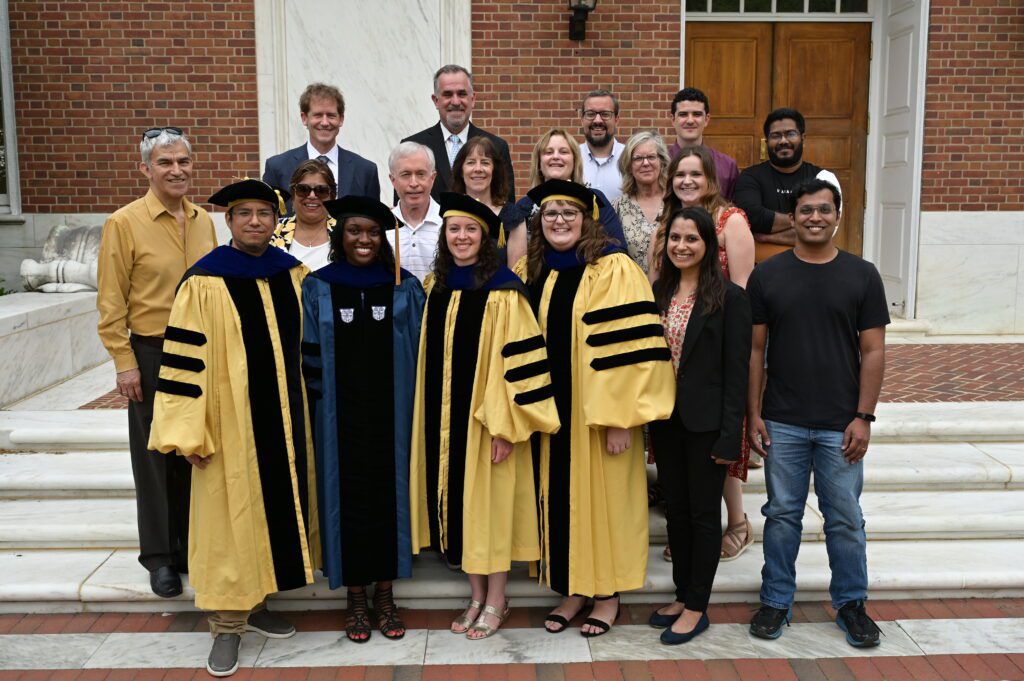
Bell grew up in Brooklyn, New York. At the age of six, she decided she would become a scientist, and as she grew older, she attended Brooklyn Technical High School. She was selected to participate in a math and science program for high-achieving sophomore students. She pursued her undergraduate degree at the Massachusetts Institute of Technology (MIT), where she earned a bachelor’s degree in mechanical engineering in 2006. She was actively involved in several organizations, including the Biomedical Engineering Society, the Black Women’s Alliance, the Black Students’ Union, and the Women’s Technology Program.
She later enrolled in graduate school at Duke University. During this time, Bell received an international Whitaker Foundation Fellowship to lead a research project at the Institute of Cancer Research and the Royal Marsden Hospital from 2009 to 2010. In 2012, she earned her Ph.D. and was selected to participate in the NextProf Workshop at the University of Michigan. Her dissertation research was supported by the UNCF/Merck Graduate Dissertation Fellowship. Bell then became a postdoctoral fellow at Johns Hopkins University, working in the Center for Computer-Integrated Surgical Systems and Technology. Her postdoctoral appointment was funded by both UNCF/Merck and the Ford Foundation.
Research in Ultrasound and Photoacoustics
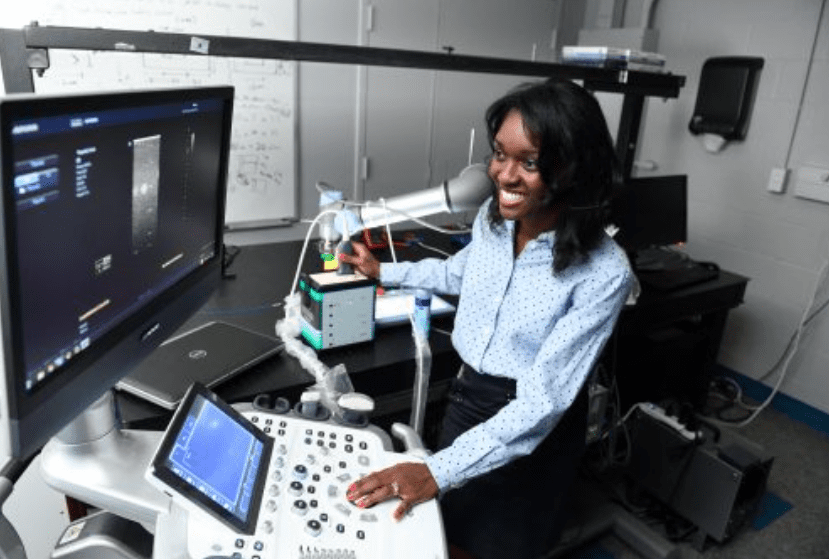
Bell joined the Johns Hopkins faculty as a research assistant professor. She collaborated with the Laboratory for Computational Sensing and Robotics on developing systems capable of controlling individual ultrasound and photoacoustic components. Her research focuses on various medical robotics applications for disease treatment and diagnostics. In 2015, she launched an online course, Introduction to Medical Imaging, on Udemy. That same year, she received the NIH K99/R00 “Pathway to Independence” Award, which enabled her to assess coherence-based photoacoustic image guidance for transsphenoidal surgery.
She holds a patent for a short-lag spatial coherence beamformer, which can be used for photoacoustic image guidance during medical procedures such as skull base surgery and prostate brachytherapy. She also provided a free MATLAB UltraSound Toolbox for processing ultrasound signals. In 2016, she founded PULSE, the Photoacoustic and Ultrasound Systems Engineering Laboratory.
Bell joined the Department of Biomedical Engineering at Johns Hopkins University as an assistant professor in January 2017. In 2018, she received the NIH Trailblazer Award for her research on using machine learning to enhance ultrasound image quality. She explored convolutional neural networks that process input data to produce clear, artifact-free images.
Scientific Achievements and Awards

In 2017, she participated in the Deep Learning in Healthcare Summit in Boston. The following year, she received a Johns Hopkins Discovery Award for research exploring the use of photoacoustic imaging in gynecologic surgeries. She was also awarded the NSF CAREER Award, allowing her to advance photoacoustic-guided surgery. This technology helps surgeons avoid damaging critical structures during procedures.
The National Academy of Engineering invited Bell to participate in the U.S. Frontiers of Engineering Symposium. She later received the Sloan Research Fellowship and was named the “Outstanding Young Engineer of Maryland” by the Maryland Academy of Sciences and the Maryland Science Center in 2019.
In 2021, Bell was honored with the SPIE Early Career Achievement Award in recognition of her significant contributions to photoacoustic imaging for surgical guidance. Her work includes pioneering technological advancements, innovative deep-learning applications for spatial coherence beamforming, and forward-thinking clinical applications.
In 2022, she was elected a fellow of the American Institute for Medical and Biological Engineering (AIMBE) for her groundbreaking contributions to ultrasound and photoacoustic imaging systems, including coherence-based beamforming, photoacoustic surgery, and deep-learning applications. Later that year, she was promoted to associate professor with tenure.
Bell is a senior member of the Institute of Electrical and Electronics Engineers (IEEE) and SPIE. She regularly attends IEEE and SPIE conferences, actively engages in the IEEE Women in Engineering community, and supports the SPIE Women in Optics initiative.