

In the past, banks were built not only for economic purposes but also as cathedrals of commerce. They conveyed strength and security through their majestic architecture. However, Brooklyn banks were distinctive not just because of the tall columns and massive bronze doors. Tiny finishing touches carved into columns and exteriors completed the picture. For example, the illustration of squirrels storing nuts for the winter is a very clear metaphor. Modern gloomy buildings with beige and glass walls and dropped ceilings hardly resemble the royal establishment of the early 20th century, which used to be called the home of our money. Read about the history of Kings County Savings Bank, one of the oldest and greatest banks in Brooklyn, at brooklyn1.one.
Second Empire style architecture
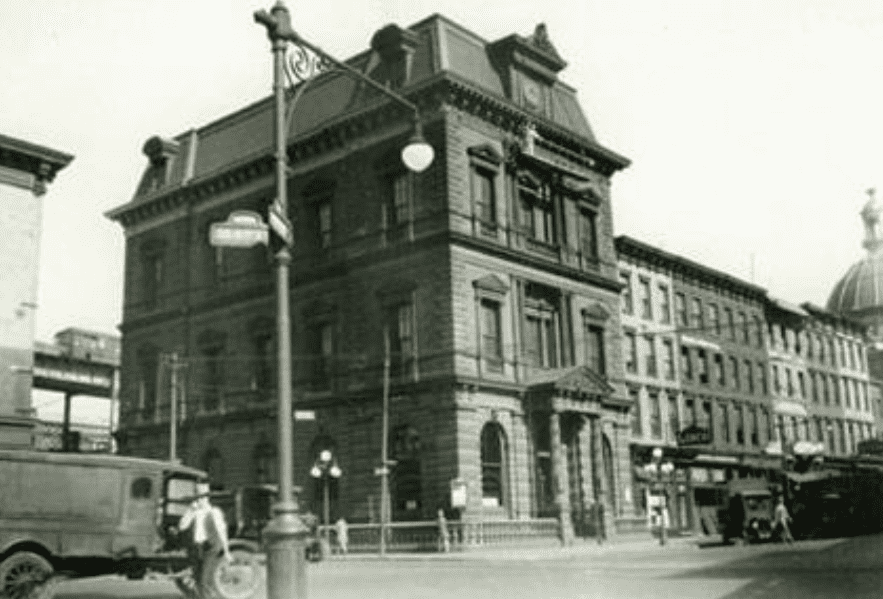
Kings County Savings Bank is a bank building that used to be located on Broadway at 135 in the Williamsburg area of Brooklyn, NY. It represents Second Empire style and was designed by W. H. Willcox from Brooklyn and the outstanding New York architect G. King in 1860. Together, they worked under the name King & Willcox. Interestingly, this building housed different banks until the 1990s. Since 1996, the building has been managed by the Williamsburg Art and Historical Center.
The Kings County Savings Bank building was constructed between 1860 and 1867. It was made of Dorchester sandstone and measured 43.5 by 81 feet or 13.3 by 24.7 meters. The three-storeyed bank houses one large room on each floor. The rooms on the first and second floors have six high Corinthian columns made of cast iron. The third floor is open. Large gas chandeliers and intricately carved wood handicrafts have been preserved on the first floor.
Even though the designer, Willcox, was not a well-known architect, the building proved to be a splendid example of Second Empire style, as evidenced by a distinctive mansard roof that conceals the garret on the fourth floor.
The highest point of Williamsburg
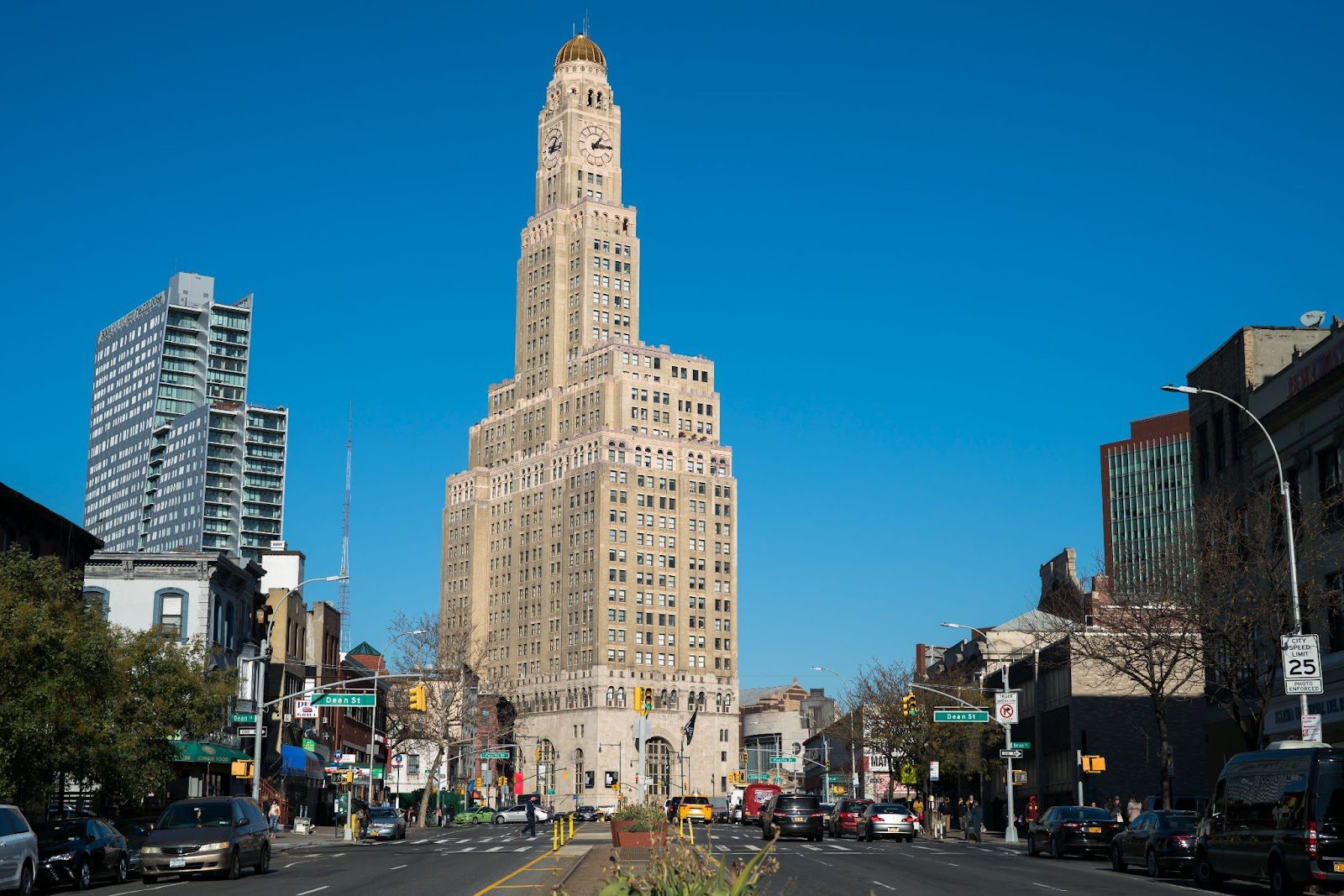
In the mid-1920s, the managers of the Williamsburg Savings Bank decided to build a new headquarters and erected a skyscraper near the center of Brooklyn. The building opened on April 1, 1929. The bank occupied the lower floors, while the upper floors were rented out for offices. By the end of the 20th century, most of the building housed dental offices. In 1977, the Landmarks Preservation Commission (LPC) of NY included the tower’s exterior to the city’s landmarks. In 1996, some of its indoor premises were awarded with this title as well. The Williamsburg Savings Bank was merged several times and then was incorporated into HSBC Bank USA, which sold the building in 2004. From 2005 to 2007, the upper floors were converted into luxury condominiums and the banking hall became a venue for various events.
What about the first building? By 1900, during the construction of the Williamsburg Bridge, the local surroundings had undergone a transformation. The original bank building was already considered an icon of old Williamsburg. It is still one of the major historical sites of this fashionable Brooklyn neighborhood. It was recognized by the LPC in 1966, becoming the seventh building to receive such a title. Additionally, the establishment was listed on the National Register of Historic Places in 1980.
Art & Historical Center
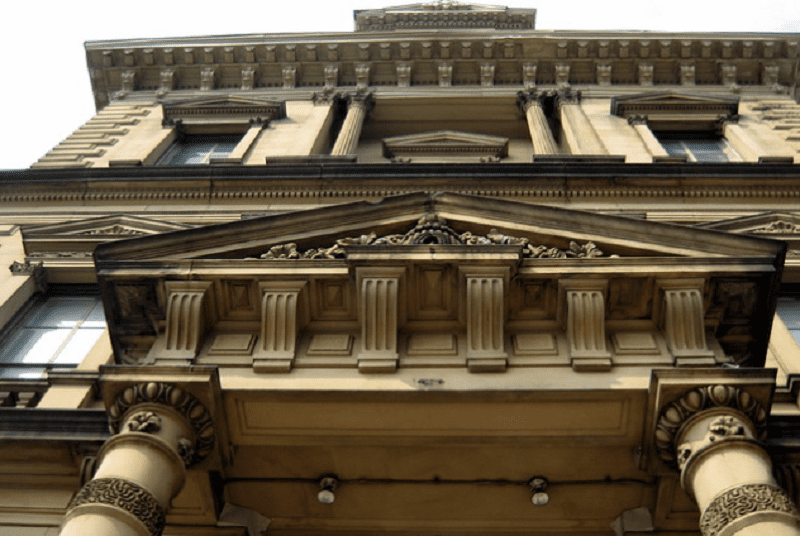
It is obvious that the Kings County Savings Bank is a remarkable example of architecture from the Second French Empire period. This is evidenced by the rich ornamentation and diverse architectural elements. The bank represents a time when people in power openly displayed their wealth without judging it. When it comes to size and exterior, the Kings County Savings Bank looks the same as the mansions of millionaires.
The bank owned and occupied this building for over a century. It stopped being used as a banking institution in the 1980s.
Now, the building is home to the Williamsburg Art & Historical Center. This is a non-profit arts organization started by artist Yuko Nii in October 1996. Exhibitions, performances and other cultural events are held in the center. Local and international artists give lectures, seminars and educational programs here. The center also keeps and exhibits historical artworks and relics.
On July 31, 2008, J. B. Manbeck, who was the official Brooklyn historian from 1993 to 2002, wrote in an article in The Brooklyn Eagle that art in Williamsburg had achieved great success. Undoubtedly, Williamsburg was advancing with the help of artists who feel affinity for this place.
Regarding the Historical Center, it currently occupies the former Kings County Savings Bank building. Therefore, it is not surprising that Y. Nii’s foundation was awarded a $500,000 grant by the city.