

For many years, Brooklyn was known as a haven for immigrants from all walks of life. However, New York City itself has always been the ultimate dream destination for many Americans and foreigners alike. This is why the hospitality industry flourished rapidly in both the city and Brooklyn. By the late 19th century, the largest hotel in Brooklyn was the St. George Hotel, occupying an entire city block. The history of this grand hotel is just as impressive as its scale. Read more on brooklyn-name.com.
The Construction of the Century
The mastermind behind the future hotel giant was architect Augustus Hatfield. Initially, he designed a nine-story building, which was the original plan.
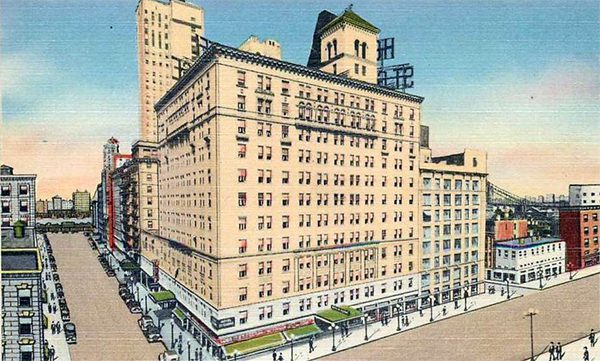
The construction site was chosen at 44 Pineapple Street. As the hotel expanded, it eventually occupied an entire block, bordered by Pineapple Street, Henry Street, Clark Street, and Hicks Street. The total area covered 441,063 square feet.
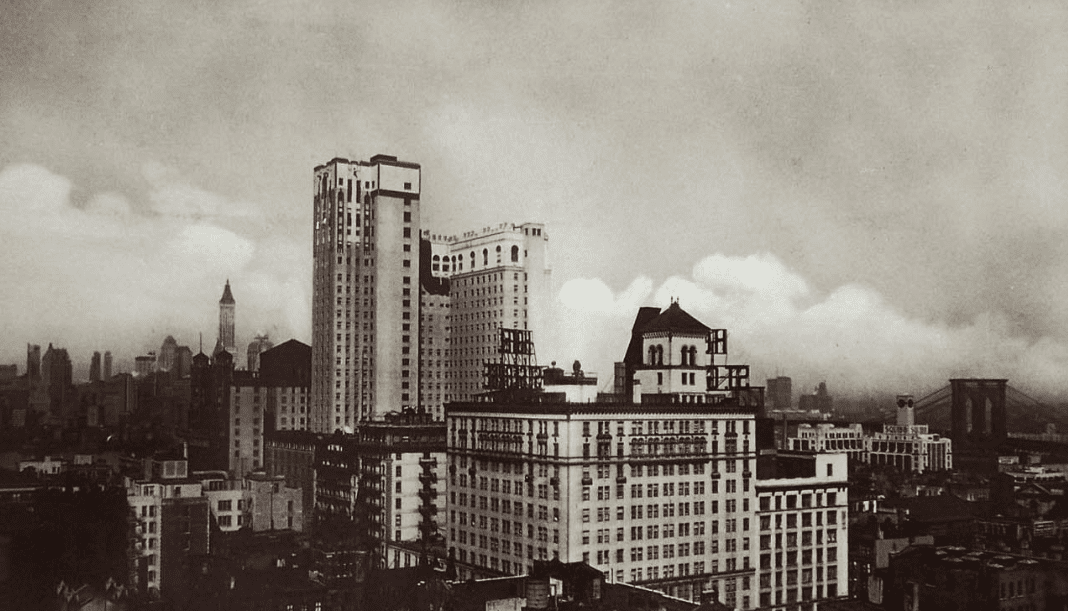
The hotel’s central structure was called the Tower Building—a massive tower featuring a real beacon with a luminosity of 480 candlepower. The light from Brooklyn’s tower was visible from a distance of 16 km (10 miles). Unfortunately, it was turned off in 1931 due to concerns that pilots might mistake it for an airport signal. To the east of the tower, six- and seven-story buildings housed guest rooms.
On Clark Street, three additional buildings of varying heights contributed to the hotel complex’s impressive skyline. However, this variation in building sizes led to issues with fire escapes and exits. Some structures were severely damaged in a 1995 fire, with the buildings on Clark Street suffering the most.
Luxury in Every Detail
The interior of the St. George Hotel was lavish. The hotel boasted 2,632 rooms. Maintaining such grandeur required a massive workforce. According to surviving records, the hotel employed about 1,000 staff members, which enabled it to accommodate up to 7,000 guests at once, providing cleaning services, fine dining, and entertainment.
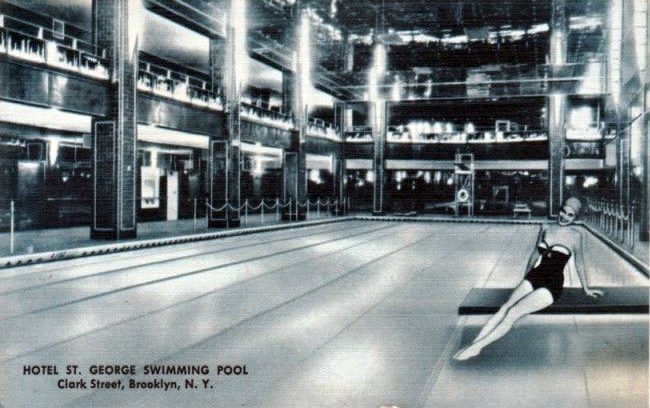
The St. George was not just a hotel—it was a full-fledged entertainment complex. It featured multiple restaurants, a grand ballroom, a saltwater swimming pool, a billiard room, a gym, a poker club, saunas, and more.
The swimming pool, in particular, was a marvel—measuring 40 by 100 feet, adorned with gilded columns and underwater lights. Between swims, guests could relax on intricately carved balconies.
To ensure uninterrupted operations, the hotel complex generated its own electricity. The only part of the hotel powered by the city’s electrical grid was the swimming pool.
The dominant interior style of the St. George was Art Deco. However, the eastern wing facing Clark Street had a slightly different design. Next to it was a laundry facility, which was later converted into lofts. The hotel was so vast that loudspeakers were installed throughout the premises to communicate with guests and staff.
A Part of the City’s History
Between 1770 and 1783, a small tavern occupied the site where the grand hotel would later stand. In the 1880s, the land was purchased, and construction began. The hotel’s founder, William Tumbridge, was a former Navy captain who made his fortune in finance, funding the construction with his own wealth.
The St. George began as a modest 10-story building with 130 rooms. Compared to the final result, it was small, but for its time, it was considered luxurious—featuring bathhouses, bowling lanes, some of the first air conditioners and generators, marble interiors, and Tiffany glasswork.
The hotel quickly became popular among visitors and the city’s elite. In 1886, Tumbridge decided to expand. Within five years, the hotel grew to 1,160 rooms. Thanks to its esteemed guests, construction progressed rapidly.
At the beginning of the 20th century, the St. George started accommodating permanent residents, operating both as a hotel and a rental apartment complex. In 1906, while drilling a well on the hotel grounds, workers discovered gold. Prospectors from across the country flocked to try their luck, further boosting the hotel’s success.
Tumbridge continued expanding the hotel until his death in 1921. His son, however, did not share his father’s passion for the hotel and sold it. The new owners, the firm Bing & Bing, purchased the property for $3 million. They embraced Tumbridge’s vision and continued expanding the hotel. By 1924, after further construction, the St. George became the fourth-largest hotel in New York City. The new owners not only built additional structures but also renovated the original ones and updated the interiors.
To finance the expansion, Bing & Bing had to take out loans, but bond sales saved the situation. By 1930, at the peak of its expansion, the St. George had 2,632 rooms, making it the largest hotel in the city and the second-largest in the country. The staff numbered 2,100 employees, and the hotel could accommodate 3,500 guests at a time. The average cost of a long-term stay was $240–$280 for a four-room apartment.
A Hub of Luxury and Elite Life
By the mid-20th century, the St. George had become a center of luxury and elite social life in Brooklyn. It was a popular venue for weddings, anniversary celebrations, and high-society events. Even U.S. presidents visited the hotel. The inaugural ball for Franklin D. Roosevelt was also held at the St. George.
However, in the 1930s, the hotel’s management began facing financial difficulties with creditors, and at one point, the hotel was even put up for auction.
Survival During and After World War II
During World War II, soldiers stationed at military facilities in Brooklyn stayed at the St. George, saving it from financial ruin.
Starting in the 1950s, the hotel’s occupancy rate declined. With the war over and the country rebuilding, Brooklyn’s military bases were closing, and new hotels were emerging, offering competition to the St. George. Poor management further exacerbated the situation. Maintaining the hotel’s former grandeur was becoming increasingly costly and complex.
By 1963, the hotel had gone bankrupt. A total of 580 rooms were permanently closed, and some sections became abandoned relics of past luxury. The hotel largely relied on its permanent residents, numbering between 1,500 and 1,900 people.
The hotel was once again put up for auction, but a buyer was not immediately found. Only 65% of the original bonds were recovered. The new owner, Vantar Properties, purchased the St. George for $2.5 million—less than what Tumbridge’s son had sold it for years earlier. However, in 1965, Vantar Properties also went bankrupt. The hotel was then acquired by the Hong Kong-based investment group TF Mok, which converted parts of the complex into apartment buildings.
The End of an Era
By the late 1960s, Brooklynites had lost interest in the St. George. Visitors were intrigued by its history, but occupancy rates continued to decline. Even renovations failed to revive the hotel’s appeal. In 1970, the New York City government ordered a portion of the hotel to be converted into housing for low-income families, relocating other guests to a more deteriorated section of the complex.
By 1975, parts of the hotel had become uninhabitable. The famous St. George Tower was deemed unfit for residents. The swimming pool was shut down, and the ceiling was literally crumbling onto guests’ heads. Renovations were deemed too expensive and unprofitable. At the time, only 40 staff members remained, and the hotel had just 500 operational rooms.
The sections on Pineapple and Hicks Streets were converted into apartment buildings, while Clark and Henry Streets retained hotel functions. By the late 1970s, developers attempted to renovate the residential portion, but the quality of repairs was subpar.
Three buildings on Clark Street were abandoned, while a hotel still operated on Henry Street. By the 1990s, the St. George had developed a notorious reputation. Its neglected areas became a refuge for the homeless and petty criminals. In 1992, part of the building was designated for housing individuals with HIV/AIDS.
A Fire and a New Purpose
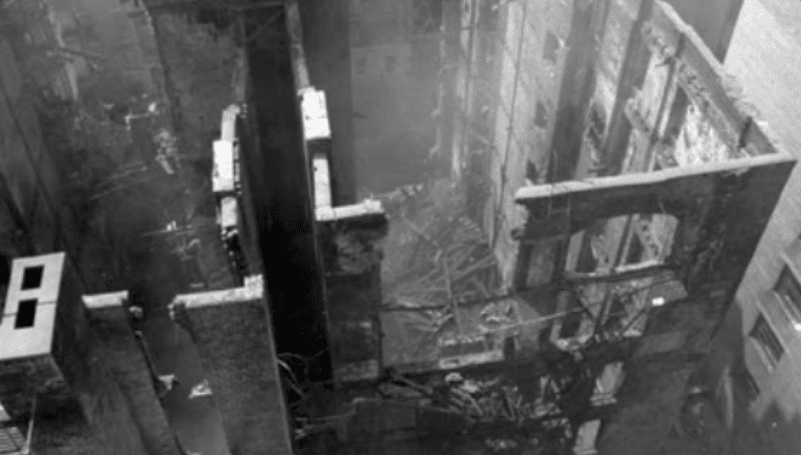
In 1995, a fire severely damaged much of the hotel. The blaze started on Clark Street. The then-owners attempted to restore the building, but full-scale renovation proved impossible. The structure was ultimately repaired and transformed into a dormitory for students of Pace University and Baruch College.
Despite its decline and failed attempts at revival, the St. George Hotel remains recognized as a historic landmark and an integral part of Brooklyn Heights.